Air Admittance Valve Brands Compared: Studor, Oatey, Ayrlett, and Tuuber Reviewed
Air Admittance Valve Brands Compared: Tuuber vs Top Brands
Air admittance valve brands compared by code fit, sealing, access, support, and project needs. Choose the right model with this practical guide.
Choosing an air admittance valve is not simply a matter of picking the most familiar name on the shelf. The right fit depends on the application, valve size, sealing design, access for inspection, manufacturer support, and the requirements enforced in your jurisdiction.
Contact Tuuber to review your AAV options
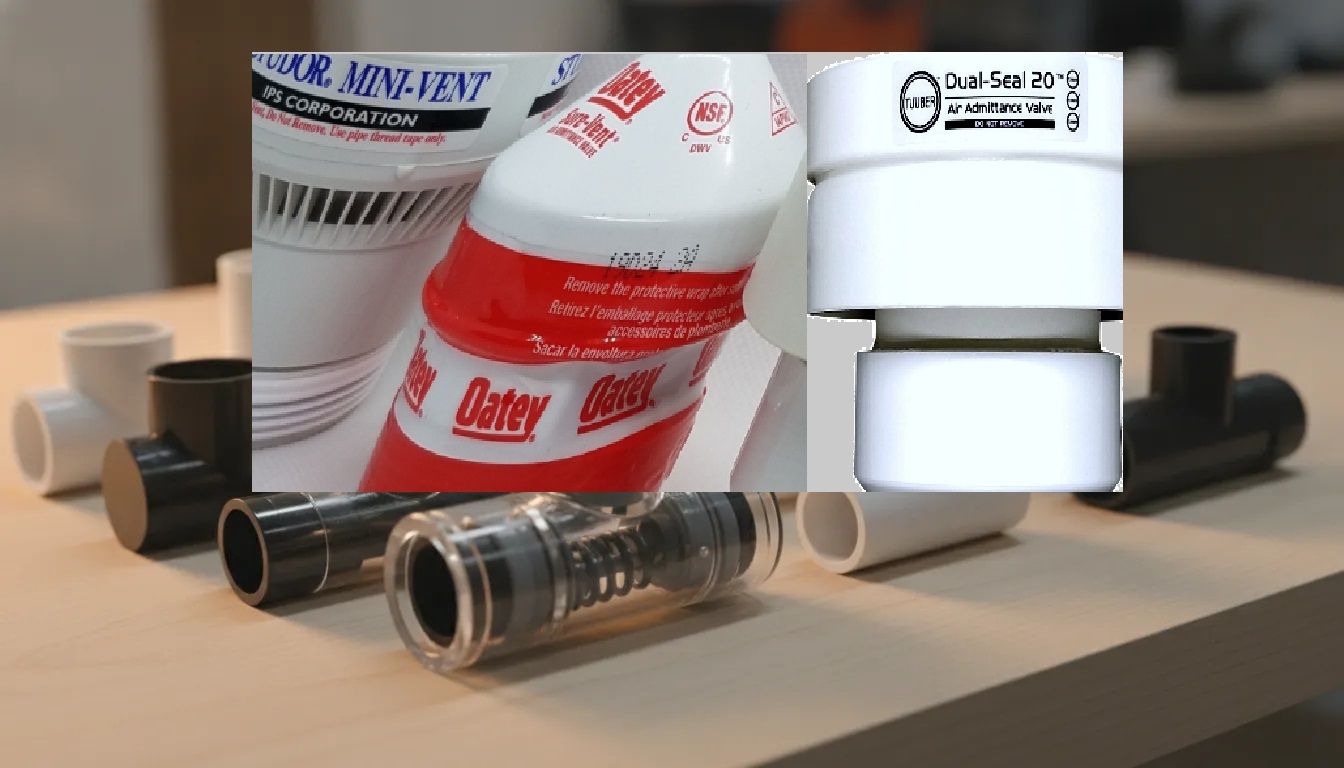
In these air admittance valve brands compared, Studor is known for pioneering AAV technology. Oatey emphasizes broad availability for common residential applications, Ayrlett focuses on compact designs, and Tuuber differentiates its products with patented Dual-Seal 20 technology. No brand is automatically right for every installation, so confirm code acceptance and follow the exact manufacturer instructions.
AAVs are one-way mechanical devices that admit air during negative pressure changes to help protect trap seals, but they do not replace every part of a venting system. Oregon code guidance notes that AAV systems still require at least one roof vent and do not protect against positive pressure events: review the technical guidance. With those limits established, the market becomes easier to evaluate by separating each brand's positioning from the installation criteria that matter most.
The Air Admittance Valve Market: Who Are the Major Brands?
Air admittance valves, or AAVs, are one-way mechanical devices installed near one or more fixtures. They admit air into a drain-waste-vent system when negative pressure develops, while remaining closed under normal conditions. This local venting approach can avoid a connection to a traditional roof vent stack. It can help when a remodel, island sink, or restricted wall cavity makes conventional routing difficult. The Oregon Building Codes Division describes an AAV as a locally installed valve that allows venting without connection to a larger venting system and stack. Read the source guidance.
The operating principle matters when comparing AAV code requirements. Gravity activation allows the valve to open as negative pressure threatens a fixture trap seal, helping maintain the water barrier that blocks sewer gases. However, an AAV is not a complete replacement for every part of a vent system. It does not protect against positive-pressure events, and the cited Oregon guidance states that systems using AAVs need at least one roof vent. Local requirements and the manufacturer's installation instructions determine whether a specific application is acceptable.
Which brands appear in an AAV comparison?
When air admittance valve brands compared searches bring up Studor, Oatey, Ayrlett, and Tuuber, the useful question is not simply which name is most familiar. Each manufacturer should be evaluated by the model's intended application, installation requirements, sealing design, access needs, and available technical documentation. Studor is presented in the research as a pioneering, broadly distributed AAV brand. Oatey offers a range of models for common residential configurations and is widely available through major retail channels. Ayrlett is associated with compact designs intended for space-constrained installations. These descriptions identify market positioning, not a blanket judgment about performance or code acceptance.
Tuuber takes a different product-design position through its patented Dual-Seal 20 technology. The customer documentation describes the design as intended to provide additional protection against trap-seal loss compared with standard single-seal mechanical designs. That feature can be relevant where long-term reliability and the risk of return visits matter. But the correct model and installation still need to be verified for the project.
A neutral framework for choosing among brands
Start with the authority that controls the installation. Confirm local code acceptance, required certifications for the exact model, fixture and pipe-size compatibility, placement, and required access for inspection or future maintenance. Then compare how each brand addresses sealing, pressure response, documentation, replacement, and technical support. A product's retail availability or compact form factor may be valuable, but neither establishes compliance by itself. For context on the design tradeoffs, review AAVs versus traditional venting before selecting a valve.
What Should You Compare When Choosing an AAV Brand?
When evaluating air admittance valve brands compared side by side, start with the individual model rather than the logo on the package. A familiar brand can offer several valves with different intended uses, connection sizes, installation requirements, and certification details. The right choice is the model that fits the project, local rules, and service conditions.
Local code and certification
First, confirm that your jurisdiction permits an air admittance valve for the specific fixture and installation. Requirements can vary by location, so DIY homeowners should check with the local inspector before purchasing or beginning a renovation. Manufacturer instructions and applicable local codes govern the installation, not brand recognition alone. The Portland code determination also advises purchasing valves certified to applicable ASSE standards. Check the certification marking and documentation for the exact model, and do not assume that every valve in a product line has identical approvals.
This step can prevent a costly replacement after the wall or cabinet is closed. Ask whether the model is accepted for the intended building type, fixture, and location. If the documentation is unclear, pause the selection and verify it with the manufacturer or code authority.
Application, capacity, and sizing
Next, match the valve to the actual application. A model intended for a straightforward residential fixture may not be appropriate for a more demanding or specialized venting arrangement. Compare the manufacturer's stated application range, connection size, installation position, and any limits on the number or type of fixtures served. Focusing on these details is more useful than choosing the brand with the most visibility.
Review the installation instructions before buying. They should explain how the valve is positioned, what access is required, and which system conditions it is designed to handle. If the instructions do not clearly address the proposed installation, select a model with better documentation or request technical guidance.
Sealing design and serviceability
The sealing mechanism deserves close attention because an AAV is a mechanical component. Mechanical valves can wear over time and may require inspection or replacement. Compare how the manufacturer describes the seal, the inspection process, and the indicators of a valve that needs service. Avoid treating a low-maintenance claim as a no-maintenance claim.
Installation access is equally important. Inspectors generally require access so the valve can be checked for compliance, and accessible placement makes future maintenance practical. Do not bury the valve behind permanent finishes or place it where a cabinet, appliance, or stored items prevent visual inspection and replacement.
Manufacturer support
Finally, assess the support available after installation. Look for complete installation instructions, model-specific technical information, and a clear way to obtain answers when site conditions are unusual. A brand comparison is incomplete if it considers only the product body and ignores the guidance needed to select, install, inspect, and replace the valve correctly.
Use this checklist to compare model documentation, not just brand names. That approach gives contractors and capable DIY homeowners a more defensible choice and helps ensure the selected valve is suitable for the specific project.
Studor: The Pioneer Brand with Broad Distribution
Studor is commonly included in discussions of air admittance valve brands because of its early role in bringing AAV technology into the United States market. The brand is described as a pioneer in the category and maintains extensive distribution networks. Which can make its products familiar to contractors, remodelers, and property owners evaluating local venting options. Those market factors explain Studor's visibility, but they do not replace project-specific product evaluation.
A broad distribution network can be useful when a replacement is needed or when a project requires access to manufacturer information through established sales channels. It may also make it easier to identify a product family that matches a common residential application. However, availability should be treated as a starting point rather than proof that a particular valve is suitable for every installation. Studor's own product information is the appropriate place to begin reviewing the options: Studor AAV product information.
Review the exact Studor model, not only the brand name
Studor offers a brand-level selection, while performance and installation details belong to the individual model. Before choosing a valve, identify the exact product and read its current documentation. Check the stated pipe size and connection details against the proposed installation. Confirm the intended fixture or system application, required orientation, location requirements, and any limitations that affect where the valve may be placed.
The model documentation should also be compared with the requirements of the authority having jurisdiction. Code acceptance is not automatically identical across every location, and a product being widely distributed does not establish approval for a specific project. Verify the applicable local rules and, where required, confirm the selection with the responsible inspector before materials are purchased or concealed work begins.
Installation requirements remain part of the comparison
Studor is also associated with specialized check mechanisms engineered for consistent valve operation in systems exposed to frequent pressure changes. That feature is relevant to a technical comparison, but it should be understood through the manufacturer's documentation for the exact model rather than generalized across an entire brand. Ask what the mechanism is designed to do, which installation conditions it assumes, and how the manufacturer addresses inspection or service.
For a fair comparison, treat distribution, product design, and documentation as separate decision factors. A familiar brand can be a practical candidate, yet the correct choice still depends on the model's size, application, installation instructions, and local acceptance. That same checklist provides a consistent basis for evaluating every brand in the comparison instead of relying on recognition alone.
Oatey and Ayrlett: Availability Versus Specialty Fit
When air admittance valve brands compared searches lead to Oatey and Ayrlett, the useful distinction is not simply which name appears first. The better question is how each brand's product positioning fits the installation in front of you. Oatey is presented as an accessible option for common residential work, while Ayrlett is associated with compact designs intended for restricted spaces. Those are different selection advantages, and neither one replaces checking the exact model documentation.
Oatey's broad retail presence can matter when a homeowner needs a replacement valve or when a contractor wants a product that is readily available through familiar purchasing channels. The brand's product range also includes models intended for different pipe sizes and residential configurations. That variety can simplify sourcing, but the model still needs to match the pipe, fixture arrangement, installation position, and applicable requirements. A familiar brand name is not a substitute for compatibility review.
Ayrlett's stated emphasis is space-saving design. That positioning may be useful in a crowded sink cabinet, a compact vanity, or another location where clearance affects the installation. A smaller form factor can make access and placement easier, but compact does not automatically mean appropriate for every fixture or vent layout. Confirm the valve's dimensional requirements, connection details, and installation clearances before choosing it for a tight space.
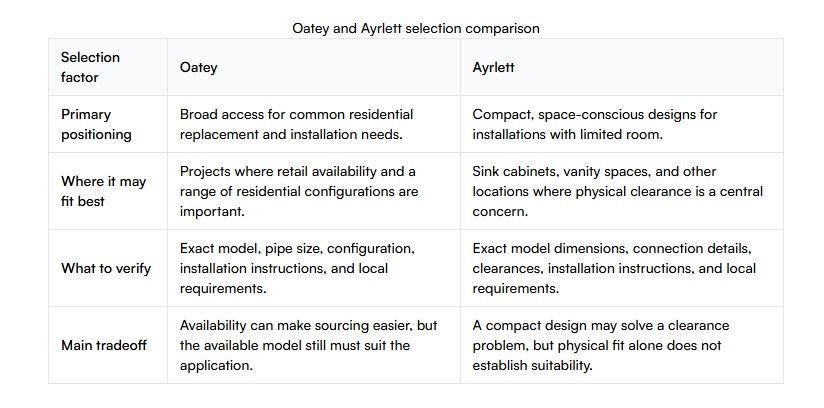
Oatey and Ayrlett selection comparison Selection factorOateyAyrlettPrimary positioningBroad access for common residential replacement and installation needs.Compact, space-conscious designs for installations with limited room.Where it may fit bestProjects where retail availability and a range of residential configurations are important.Sink cabinets, vanity spaces, and other locations where physical clearance is a central concern.What to verifyExact model, pipe size, configuration, installation instructions, and local requirements.Exact model dimensions, connection details, clearances, installation instructions, and local requirements.Main tradeoffAvailability can make sourcing easier, but the available model still must suit the application.A compact design may solve a clearance problem, but physical fit alone does not establish suitability.
The comparison is therefore practical. Choose Oatey when accessible sourcing and model variety are important parts of the project. Consider Ayrlett when the installation has a genuine space constraint and the selected model provides the required connections and clearances. In either case, compare the installation instructions rather than relying on a general brand summary. Confirm that the selected valve is intended for the specific fixture and arrangement, and retain the documentation for future service or inspection.
Local rules also control whether and how an air admittance valve may be used. Before purchasing or closing a wall, cabinet, or access panel, verify the requirements with the authority having jurisdiction and follow the manufacturer's current documentation for that model. The final decision should balance availability or compact fit with code acceptance, accessible placement, and a clear maintenance path. That process produces a more defensible choice than selecting whichever valve is easiest to find or smallest on the shelf.
Why Tuuber Stands Out in This Brand Comparison
Tuuber's clearest point of difference is its patented Dual-Seal 20 technology. Many air admittance valves rely on a single sealing interface. Tuuber uses a dual-seal design intended to provide added protection against trap-seal loss if one sealing point is compromised. That redundant approach addresses a practical concern for contractors and building maintenance teams: a venting component should continue to provide dependable protection against sewer gas intrusion. Rather than turn a small mechanical fault into a service call.
The technology is not a substitute for correct system design. Air admittance valves are one-way mechanical devices, and their performance depends on appropriate placement, sizing, installation, and operating conditions. Local requirements and the manufacturer's instructions still control. Where a project requires ASSE 1050 or ASSE 1051 certification, confirm the certification and application for the exact model being specified. Do not assume that every valve in a product range has identical approvals or is suitable for every installation.
Redundant sealing can support long-term reliability
A failed seal can allow odors to enter a room and can create a callback that is costly in labor and customer confidence. Tuuber positions Dual-Seal 20 as a way to reduce the risk of total valve failure compared with standard single-seal designs. That is a reliability feature, not a promise that a valve can never wear out. Like other mechanical components, an AAV should remain accessible for inspection and eventual replacement.
For a deeper explanation of how seal failure can affect indoor air quality, see Tuuber's guide to failed AAV seals. The practical takeaway is straightforward: a more resilient sealing design can help protect the completed installation. But only when the valve is installed where it can be checked and serviced.
Selection still depends on the model and application
Tuuber's range is intended for different residential and commercial venting needs, so selection should begin with the fixture layout and the available connection size. Review the pipe diameter, airflow requirements, installation orientation, access conditions, and local code requirements before choosing a model. A compact cabinet installation may call for a different fit than a larger commercial application. The right question is not simply which brand has the most features. It is whether the specific model matches the system and can be maintained after the wall or cabinet is closed.
Tuuber's Tuuber Dual-Seal 20 AAV product page provides the starting point for reviewing the product range and installation information. Contractors can also use Tuuber's technical resources and support when confirming model selection or working through installation questions. That support matters because professional reliability includes more than the valve itself. Clear instructions, accessible documentation, and responsive technical guidance can help prevent avoidable installation errors and callbacks.
In this comparison, Tuuber is best understood as the option focused on redundant sealing and installation support. It may be a strong fit when long-term reliability is a priority, provided the selected model meets the project's code, certification, size, and access requirements.
Are Air Admittance Valves Allowed Everywhere?
No. Whether an air admittance valve is acceptable depends on the adopted code, the authority having jurisdiction, the fixture arrangement, and the manufacturer's installation instructions. A valve can be appropriate for a residential sink or another approved fixture location, yet be unsuitable for a specialized system or prohibited in a particular jurisdiction. Before selecting a product from the air admittance valve brands compared here, confirm the local requirements for the exact project.
AAVs manage negative pressure, not every venting condition
An AAV is a one-way mechanical device. Under negative pressure, it opens to admit air and help protect a fixture trap seal from losing its water barrier. It is not designed to relieve positive pressure. For that reason, an AAV-only arrangement is not a universal substitute for the system's venting design. The Oregon Building Codes Division explains that installations using AAVs need at least one vent terminating through the roof. Read the state's AAV code requirements guide alongside the code adopted for your location.
This distinction matters when reviewing a remodel, an island fixture, or a space where a conventional vent route is difficult. The valve may solve a local air-admission need, but it does not remove the need to account for pressure behavior throughout the drainage and vent system. The design still has to follow the applicable code and the product instructions.
Local approval controls the installation
Code acceptance is not determined by brand recognition alone. The local building department or inspector may limit where AAVs can be used, require a particular installation method, or ask for documentation for the selected model. Requirements can vary between states and municipalities, and a rule that applies to one fixture type may not apply to another. DIY homeowners should check with the local inspector before purchasing or closing a wall. Contractors should verify the requirement during planning and keep the manufacturer's instructions available for review.
Access and application limits are part of compliance
Place the valve where it remains accessible for inspection, service, and eventual replacement. A mechanical component can wear over time, so burying it behind finished construction creates a maintenance problem even when the initial installation appears to work. Follow the required clearances, orientation, and location rules for the specific model.
Some applications may be restricted or unsuitable altogether. For example, Wisconsin rules identify areas of negative pressure, including certain laboratories and research facilities, as restricted locations. The same rules prohibit using an AAV as the vent termination point for a fixture serving a chemical-waste system or for a vent serving a sump. These examples should not be treated as a complete list for every jurisdiction, but they illustrate why the system's environment matters. Confirm specialized applications directly with the authority having jurisdiction and the manufacturer before installation.
The practical test is simple: identify the fixture and system, confirm the pressure conditions. Verify that the required roof vent is present, check local approval, and preserve access to the valve. Those steps are more reliable than assuming every listed brand or every AAV model is permitted in every location.
Final Verdict: Air Admittance Valve Brands Compared for Your Project
When air admittance valve brands compared are evaluated fairly, the best choice is rarely determined by name recognition alone. Studor, Oatey, Ayrlett, and Tuuber can each be relevant, but the right fit depends on the installation. The local code requirements, the valve's sealing design, and the level of support available when questions arise.
Start with the application. Confirm the required valve size, fixture arrangement, available clearance, and expected access before selecting a brand. A compact model may suit a restricted cabinet, while another installation may call for a different configuration. Do not assume that valves are interchangeable simply because they perform the same basic function. Verify the manufacturer's instructions and confirm acceptance with the local authority or inspector.
Code documentation should be part of the selection process, not an afterthought. The applicable requirements can vary by jurisdiction and by installation type. A valve also needs to remain accessible for inspection and future maintenance. Concealing a mechanical component behind a permanently closed surface can make diagnosis and replacement unnecessarily difficult. For a practical review of the rules that may affect your project, see Tuuber's guide to the best air admittance valves, then verify the final requirements locally.
Next, examine how each product approaches sealing and pressure management. AAVs are intended to admit air during negative-pressure conditions, helping protect trap seals. They do not replace every part of a complete venting system, and they are not designed to handle positive-pressure events. Product documentation should explain the intended use clearly. Mechanical valves can also wear over time, so serviceability and replacement access matter as much as initial installation.
For contractors, warranty terms, technical resources, and responsive support deserve the same attention as model selection. These factors can affect troubleshooting time and the likelihood of avoidable callbacks. For DIY homeowners, clear instructions and an easy-to-verify fit can be equally important. A brand that offers a suitable model but lacks usable installation guidance may not be the best practical choice for a particular project.
Tuuber is the logical option when redundant sealing is a priority. Its patented Dual-Seal 20 design is intended to provide enhanced protection against trap-seal loss compared with standard single-seal mechanical designs. Tuuber also provides installation resources and technical support for code-aware installations. That does not make every Tuuber model right for every job. It also does not remove the need to confirm local requirements. The brand is worth closer consideration when long-term sealing performance, access, and support are central to the decision.
The final checklist is simple: match the model to the application, verify code documentation. Select the correct size, plan accessible placement, understand the sealing design, and confirm available support. Choose the brand that satisfies those requirements with the clearest evidence, not merely the most familiar label.
Contact Tuuber for product guidance
Frequently Asked Questions
Are all air admittance valves interchangeable?
No. Match the valve to the pipe size, fixture application, installation location, and the manufacturer's instructions. Local requirements also control whether a specific valve may be used, so confirm approval with the authority having jurisdiction before replacing a unit. See the Portland code guidance.
Which air admittance valve brand is best for professional projects?
There is no universal best brand. Contractors should compare application fit, sealing design, access for inspection, installation guidance, support, and documented compliance. Studor, Oatey, Ayrlett, and Tuuber occupy different positions, so the right choice depends on the system and the requirements that must be verified for that job.
What is the benefit of a dual seal air admittance valve?
A dual-seal design adds redundant sealing protection rather than relying on one sealing interface. Tuuber's patented Dual-Seal 20 technology is designed to provide enhanced protection against trap-seal loss compared with standard mechanical designs. Review the applicable model documentation before specifying it.
Can I use any air admittance valve for a DIY repair?
No. First verify that local rules permit an AAV for the specific fixture and that the selected model matches the installation. Follow the manufacturer's instructions, keep the valve accessible for inspection and maintenance, and ask the local inspector when requirements are unclear. AAV use is not permitted in every application or jurisdiction.
How long do air admittance valves typically last?
Service life varies with usage and the environmental conditions at the installation site. Because an AAV is a mechanical component, inspect it when troubleshooting odors or venting problems and replace it if its operation or seal performance is no longer reliable.
Ready to Review Your AAV Options?
Choosing among air admittance valve brands depends on the application, installation requirements, sealing design, and local code.